June 15, 2026 · 1,890 words · 9 min read
The gap between agentic AI and enterprise reality
Roughly 40 tools in five months. Built solo.
I use some of them daily, others run quietly as background services. Some stayed experiments, others have become real working tools by now. They didn’t emerge as a collection of demos, but across very different work areas: email automation, document RAG, knowledge management, native apps, server services, orchestration, and observability.
Two years ago, that range would have sounded like a small product team: product understanding, backend, frontend, infrastructure, testing, documentation, operations. Today those roles don’t simply disappear, but their boundaries shift. Product owners build prototypes, developers write PRDs, test cases, and documentation, business units test ideas directly against the system, and infrastructure, operations, and monitoring become part of the same workflow.
The point is not that one person suddenly replaces an entire product team. The point is that the loop between problem, solution, test, and operation has collapsed dramatically. Agentic workflows help plan, implement, check, and refine tasks, not once, but in loops, until a usable result emerges. What used to take weeks or months now often emerges in days or weeks as a first dependable version.
This isn’t a hero story. It’s a signal of how large the gap has become.
What’s possible today
Many of the tools that came out of this look suspiciously similar to tasks companies still do manually today.
Email triage and inbox processing
One tool reads my inbox, recognizes relevant messages, and translates what matters into concrete tasks. It extracts the context and creates tasks in my task app via API, which I then work through.
This is where a demo parts ways with a system you can trust. An email is never trusted input; it can carry a prompt injection, hidden instructions aimed at the AI. So its content is treated as data, not as a command. The tool is allowed exactly one thing: to add a proposed task to my own list. It cannot send mail, delete anything, pay anything, or trigger any external action. The worst case of a manipulated email is therefore a junk entry that I click away. The decision stays with the human; only the sorting is automated.
Document self-service and knowledge management
RAG over project and knowledge documents: questions in natural language, answers with source citations. Instead of knowledge rotting in folders, wikis, or mailboxes, it becomes queryable.
Automatic documentation and guides
From bullet points, code, or notes come wiki pages, tutorials, and technical documentation. Exactly the documentation everyone knows is important, and that nobody writes anyway.
Agentic pipelines
Workflows that scan sources, evaluate information, generate content, and track results. They don’t just give answers, they coordinate steps of work.
Attention filtering and summaries
From hundreds of articles, emails, and sources comes a short, relevant overview: What’s important? What concerns me? What can I ignore?
Server and infrastructure automation
Setup, operation, documentation, monitoring, and recurring maintenance steps, the kind of things that otherwise create a lot of manual work.
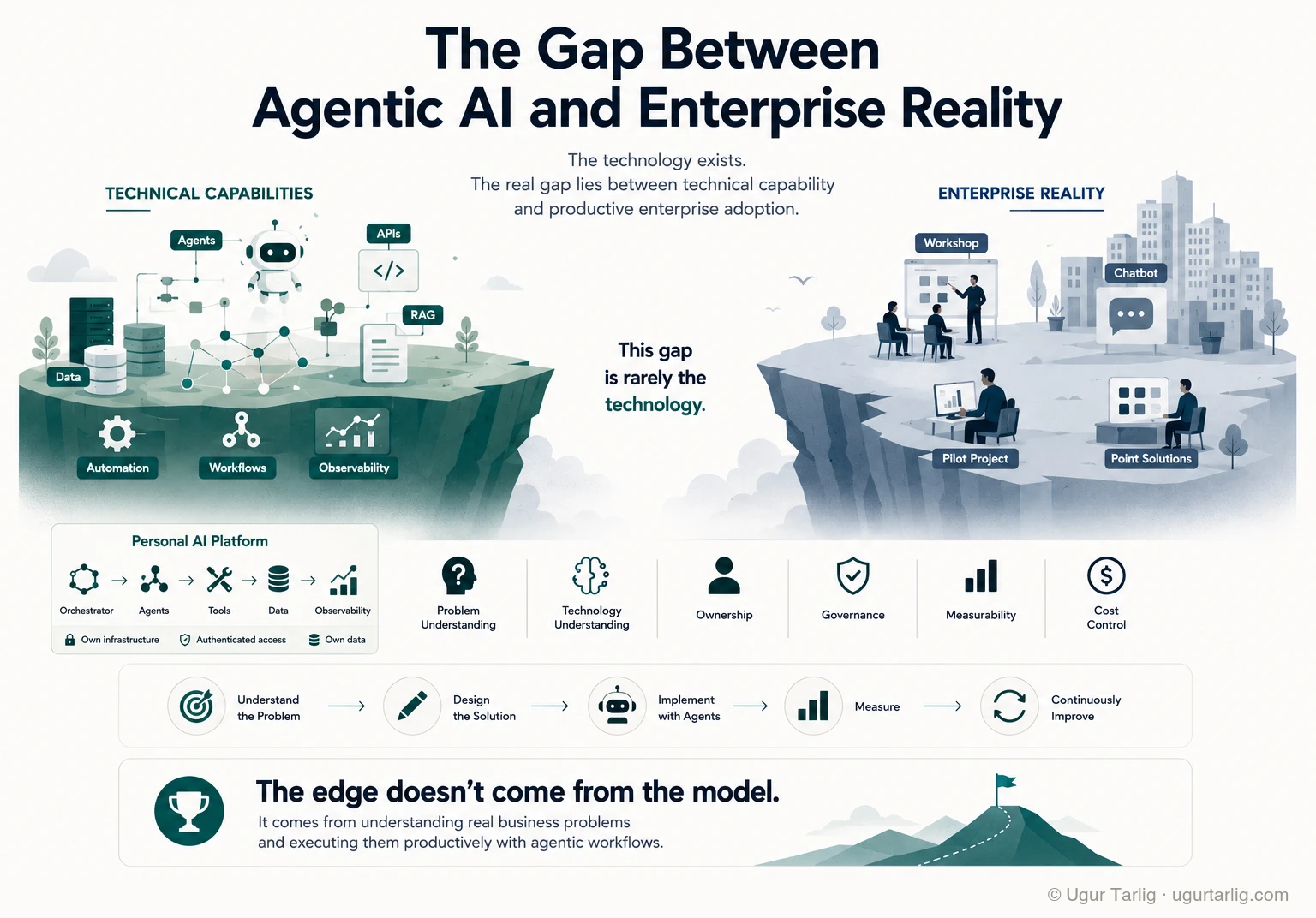
And beneath it lies the genuinely interesting layer: an orchestrator that coordinates multiple agents until a task is done. The whole thing runs on my own infrastructure, reachable through a secured interface I use to automate many personal workflows. A kind of personal “life OS”, but under my own control: own infrastructure, authenticated access, own data. On top of that sits an observability layer that makes token consumption and cost visible.
This isn’t simply “I use an AI tool”, it’s a control layer for work. And it’s exactly at this layer that real adoption hangs in companies.
The gap is rarely the technology
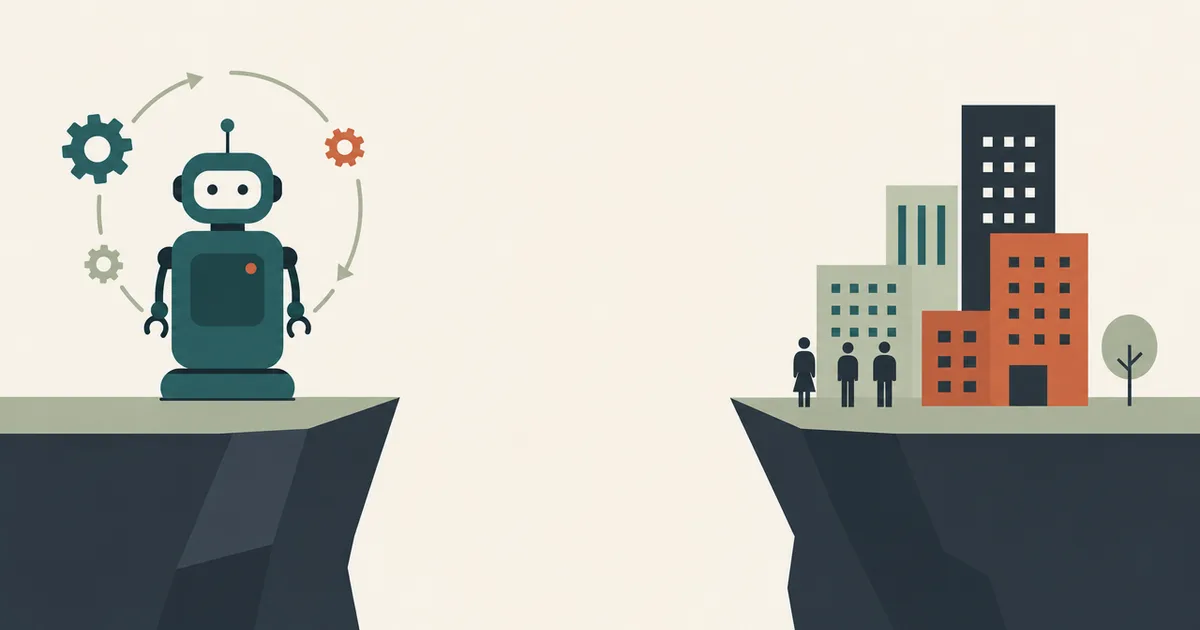
That’s one world: what’s possible today. The other world is what actually lands in many companies. And between them, there’s usually no technology gap.
The models keep getting better, the tools more accessible, the infrastructure more available. APIs, RAG, agents, local models, cloud offerings, orchestration, observability: much of it is already usable in practice today. And yet, in many organizations, AI stays a pilot project at the margins. A workshop, a chatbot, an internal demo case, a “we should roll out ChatGPT sometime”. But the leap into real, productive, measurable workflows often fails to happen.
Why? Because the actual hurdles start earlier.
AI is not a starting point
The most important point comes before technology, governance, or cost: AI is not a starting point, it’s a possible solution building block. The starting point is a sharply understood problem. Anyone who starts with “we need AI” is already a step too late.
The better question is: which problem do we want to solve? A lot of further questions hang off that one.
- How does the area actually work?
- Where do waiting times arise?
- Where do media breaks arise?
- Where is work done twice?
- Which decisions are critical?
- Which data is reliable?
- Where is automation sensible, and where dangerous?
- What should a system prepare, what should it decide, what should it merely make visible?
I experienced this myself when I built a GenAI platform for a specialist department. The long part wasn’t the technical implementation, it was understanding the domain deeply enough to even know which problem was worth solving.
Only once you truly understand the work can you decide whether AI is even the right solution, and if so, what kind of AI: a chatbot, a RAG system, an agent, a workflow automation, an assistive system with human-in-the-loop, or perhaps, at first, no AI at all, but better data, better processes, or clearer ownership.
AI does not solve a fuzzily understood problem. In the worst case, it just scales the fuzziness.
Technology understanding in management
The second bottleneck is technology understanding. Many decision-makers know AI mainly as a chatbot, and that’s understandable: for many people, ChatGPT was the first real contact with generative AI. But agentic systems are not a better search engine. They can prepare, structure, execute, check, and coordinate work, they can call tools, process data, plan chains of tasks, evaluate intermediate results, and keep working with feedback loops.
Anyone who understands AI only as a chat window doesn’t see these use cases. Then the strategy stays at the level of “we should roll out ChatGPT”, and that’s not enough. Not because ChatGPT is unimportant, but because the real lever isn’t giving every employee yet another tool. The lever is rethinking real workflows.
- Which recurring decisions can be prepared?
- Which documents can be made accessible automatically?
- Which support cases can be pre-qualified?
- Which reports no longer need to be produced manually?
- Which domain processes could be supported by agents but remain controlled?
For this, management doesn’t need detailed knowledge of every model. But it needs a mental model of what these systems can do, where their limits lie, and how work changes because of them.
Ownership of adoption
The third point is ownership. In many companies, no one is truly responsible for AI adoption. IT might provide tools, business units have ideas, legal and compliance have justified concerns, management wants to see innovation, individual teams build pilots. But who holds the mandate to turn that into real usage?
Without that ownership, AI stays a permanent pilot. There’s enthusiasm in the workshop, a few good demos, and maybe isolated productivity gains among power users, but no broad change. Adoption doesn’t mean unlocking a tool. Adoption means changing ways of working, and that takes enablement, clear use cases, training, support, success measurement, governance, and someone who actually drives the rollout.
Governance is not a prohibition problem
Governance is real, especially in regulated settings. Concrete questions come up there.
- Which data may be used?
- Which sources are dependable?
- Which actions may an agent perform?
- What must be logged?
- Where are approvals needed?
- Where does the human stay in the loop?
- What may run locally, what in the cloud?
- Which results must be traceable?
But governance must not mean “we forbid everything until every risk has disappeared”, because then nothing happens at all. Governance has to mean “we design systems so they can be used safely”. That’s a design and engineering problem. RAG systems need source citations, agents need permission boundaries, production systems need logs and monitoring, critical actions need approvals, data flows must be traceable, and users must understand what a system can do and what it can’t.
Especially in regulated settings, the decisive question isn’t whether AI agents take over workflows, but how you make them local, compliant, traceable, and trustworthy. That’s the actual work.
Measurability decides adoption
Adoption doesn’t happen because a tool is available. Adoption happens when teams notice: this work now runs noticeably better. So you need measurability.
- How much does cycle time drop?
- How many tickets get resolved faster?
- How much documentation effort goes away?
- How many more tasks does a team manage at the same quality?
- How quickly do new employees become productive?
- How much does the consistency of results increase?
- How much time do experts win back?
Without measurability, AI stays an experiment. With measurability, it becomes a steering instrument. This isn’t about throwing unrealistic productivity promises into the room. Not every activity suddenly becomes 50 percent faster, not every process is equally suited, not every person works the same way. But that’s exactly why you have to measure. A good AI use case shouldn’t just work technically, it should show whether it really improves the work.
Cost control comes later, but it comes
Cost control matters, but it’s often not the first problem. Many companies aren’t yet at the point where tokenomics really hurts. Not because cost is irrelevant, but because agents aren’t yet running broadly in production. Once that happens, it changes, because almost every step generates cost: agents in loops, more context, tool calls, failed iterations, uncontrolled automation.
That’s why you need observability, usage tracking, and clear limits.
- Which workflows consume how many tokens?
- Which agents run too long?
- Which tasks are too expensive for the value?
- Where is a smaller model worth it?
- Where do you need caching, better prompts, or clearer stop conditions?
No measurement, no steering. Tokenomics sounds abstract until an agent runs in a loop and no one sees what’s happening. Then observability suddenly stops being a nice-to-have and becomes a precondition.
The edge doesn’t come from the model
The edge doesn’t come from the best model, because soon everyone will have that. The models get stronger, cheaper, and more interchangeable, and the real competitive advantage isn’t having access to AI. It lies in understanding real domain problems, and bringing agentic workflows into those processes productively, controllably, and measurably.
That’s the difference between AI as a gimmick and AI as an operating system for work: not a single chatbot, not a pilot project, not an innovation workshop, but a new control layer for knowledge, decisions, and workflows.
The companies that close this gap first aren’t one feature ahead. They’re a whole cycle ahead.
Not someday. Now.